
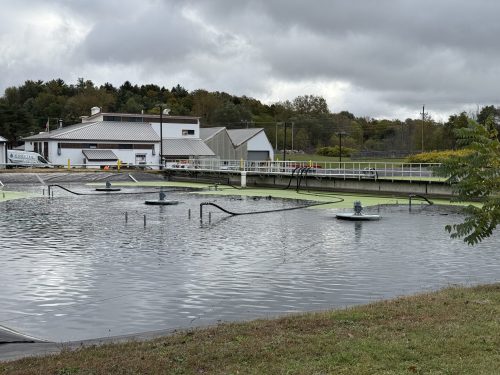
Four installations. Four configurations. One biological platform.
Fixed-film biological treatment is a simple and effective solution for lagoon systems. While the basic biology is consistent, the specific design and technology chosen depend on factors like the lagoon’s shape, local climate, ease of access for operators, and regulatory requirements.
The four installations highlighted below demonstrate how that flexibility translates into practice. Spanning a watershed protection project in central New York, a high-altitude Colorado mountain town, a coastal Oregon treatment facility, and a rural Ohio farming community, each employs Entex’s Submerged Fixed-Film (SFF) technology—WavTex, Webitat, or a combination of both—configured to address a unique set of site-specific challenges.
Matching Technology to Hydraulic Function – Skaneateles, NY
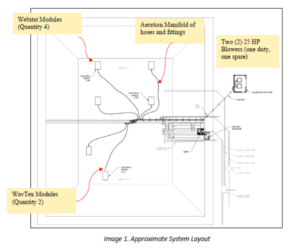
Unlike most lagoon retrofits, which are driven by winter nitrification requirements, the Skaneateles WWTP retrofit was designed around a summer ammonia limit of 2.0 mg/L NH₃-N. The solution combined both of Entex’s core SFF technologies, with each selected to match the hydraulic function of its lagoon zone.
Four Webitat modules were installed in the first lagoon, where complete mixing was the primary design objective. Two WavTex modules were installed in the upstream half of the second lagoon, while the downstream half was intentionally left quiescent to promote final settling before discharge to Skaneateles Creek. The differing mixing characteristics of Webitat and WavTex supported the distinct hydraulic functions of the two lagoons, allowing each technology to serve its intended role within the treatment process. The system reached full startup in October 2024.
Designing for Extreme Alpine Conditions — Lake City, CO
Lake City’s lagoon retrofit was designed to accommodate future flows of 0.275 MGD under severe alpine winter conditions requiring an insulated lagoon cover. Those conditions shaped both the structural design of the WavTex system and the construction approach.
To accommodate the insulated cover, only the aeration drop pipe extends six inches above the water surface through a dedicated support structure, while all other frame components remain fully submerged. The remote location and short construction season also made minimizing field assembly a priority, so all below-waterline air piping was pre-assembled prior to delivery, leaving the drop pipe as the primary field connection for each module.
The lagoon’s 2% longitudinal floor slope presented an additional design consideration. Each WavTex frame was fabricated with a matching slope to maintain level integrated aeration grids and ensure even air distribution. Phase I of the installation, consisting of five of the total nine modules, started up in September 2025.
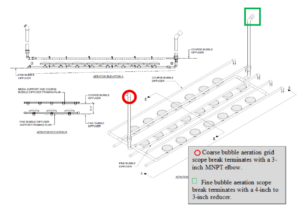
Image 2. WavTex Custom Sloped Design
Floating Deployment for Challenging Lagoon Bottom Conditions – Tillamook Bay, OR
Where lagoon floor conditions are variable, poorly documented, or inaccessible, a floating configuration eliminates the need to fully characterize the lagoon bottom. At this coastal Oregon facility, the lagoon had a total depth of 9 feet but an operating depth of only 6 feet, indicating an approximately 3-foot sludge blanket that made floating deployment the preferred approach.
Two floating WavTex modules were installed in December 2025 and secured with stainless-steel braided mooring cables anchored to shore posts. Air is supplied from shore-mounted blowers through flexible floating hose. With a combined ammonia removal requirement of just 18 lb/day, the project demonstrates how a floating WavTex system can provide a practical, cost-effective retrofit for facilities with relatively modest treatment demands, avoiding the need for extensive lagoon modifications.
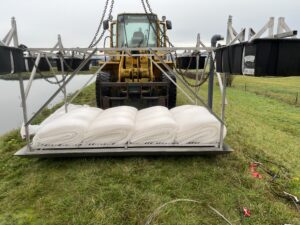
Image 3. Float Style WavTex
Beyond Retrofits: New Onshore SFF Construction — Hamler, OH
Fixed-film media is most often associated with lagoon retrofits, but the Village of Hamler demonstrates how a lagoon-based SFF approach can also be incorporated into new construction. As part of a broader plant upgrade, the Village constructed a dedicated post-lagoon WavTex tank housing three modules for ammonia polishing at a design flow of 0.113 MGD.
Rather than installing the modules directly in the lagoon, the Village selected a standalone onshore tank to simplify operation and maintenance. The dedicated tank consolidates the modules in a single accessible location, allows localized blower placement, and maintains a constant water depth. Flow passes from the lagoons through the WavTex tank before final discharge. The modules were installed in March 2025.
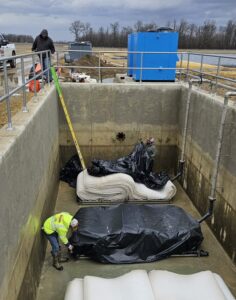
Image 4. Custom Tank
The Through-Line
Across these four installations, the biological mechanism remains the same: EnTextile media provides the attachment surface, the aeration grid supplies oxygen and drives mixing, and the fixed biomass performs BOD reduction, nitrification, and, where applicable, total nitrogen removal. What changes is the implementation—in-lagoon or onshore, floor-mounted or floating, single technology or hybrid, standard or structurally adapted to the site. Each configuration reflects the unique hydraulic, environmental, operational, and construction constraints of the facility.
That adaptability is fundamental to lagoon-based fixed-film treatment. Rather than forcing sites to conform to a standard design, the technology can be configured to meet the specific demands of each application.